


What is breath work and is science eventually catching up with what the Ancients knew?
Consciously controlling the breath in order to increase physical, mental and emotional wellbeing has been around for thousands of years. Records confirming this appear in many ancient cultures around the world, beginning in ancient Mesopotamia to the practice of Indian Yogis, Hawaiian kahunas, Buddhist monks, Martial Artists and Christian Monks. They believed that breathing had an important role in tapping into a universal energy to aid balance, healing and wellbeing.
Science tells us that there are hundreds of thousands of messages going from the brain to the body, and from the body to the brain at any one time via chemical, hormonal and electrical means. Messages from the respiratory system have a rapid and powerful effect on the brain. This has to be the case because if you stop breathing, or the airway is blocked, the brain has about three minutes to work out how to breathe again. The ancients knew that if you could send a message to the brain to calm down in a language it understood, it would work better than just saying to one’s self “clam down”.
More recently, about one hundred years ago, autogenic training was developed by Heinrich Schultz and involves an element of controlled breathing with relaxation. All forms of meditation involve either attention paid to the breath or the slowing down of the breath.
Today there is a raft of therapists and doctors promoting breathing techniques for not only relaxation but as tools for managing anxiety and anxiety-based disorders from OCD, panic disorder, insomnia to PTSD.
THE SCIENCE, HOW DOES IT WORK?
In a nutshell – The rate at which we breath has an effect on the rate at which our heart beats, this is an indication that a number of other processes have also kicked in that keep us in balance. These systems include immune response, healing, digestion and absorption. In fact, most people are aware that we can tell how much the body is in a relaxed state by measuring our pulse. So, breathe work is about using your breathing in a conscious manner to keep your body in balance, also called homeostasis. However, in time and with practice, breathe work that keeps you calm can become second nature. This is because you begin to breathe at the optimum rate for your body to be in the best possible state of wellbeing. When the body goes into a relaxed state it then feeds back to the brain that all is well and the brain begins to calm down.
The majority of our bodily functions are controlled out of our awareness one major system is called the autonomic nervous system. Here comes a slightly more detailed description of the above. It is composed off two parts; one part reacts to threat or danger and gets the body ready to run or defend itself (Flight or Flight) and the other part brings this highly aroused state back under control and helps us calm down and relax (Rest and Digest). The sympathetic nervous system is the medical name for “fight or flight” and the parasympathetic sympathetic nervous system is the medical name for “rest and digest”. You cannot have one without the other. They work opposite each other in order to keep us in balance or homeostasis.
When we detect danger or feel threatened there is an immediate response by the sympathetic nervous system; messages flood from the brain to body to “get ready”. The chemicals noradrenalin, adrenalin and cortisol are released to affect changes in the body. The body needs energy to fight or run; this comes from using oxygen from the air we breathe to burn the stored energy in the form of glucose or fat we have in our muscles. Therefore, we need the lungs to work very quickly and take in as much oxygen as possible and it does this in short shallow rapid breaths. The heart then has to speed up to push the newly oxygenated blood as fast as possible to the necessary muscles. Sweating is triggered sometimes to cool this heat producing energetic process down. This process takes up a lot of energy so it also shuts down or reduces other energetic processes not immediately important; processes like digestion, sex, healing and fighting disease. During the “burning” of energy within the cells releases free radicals that damage cells and cause inflammation.
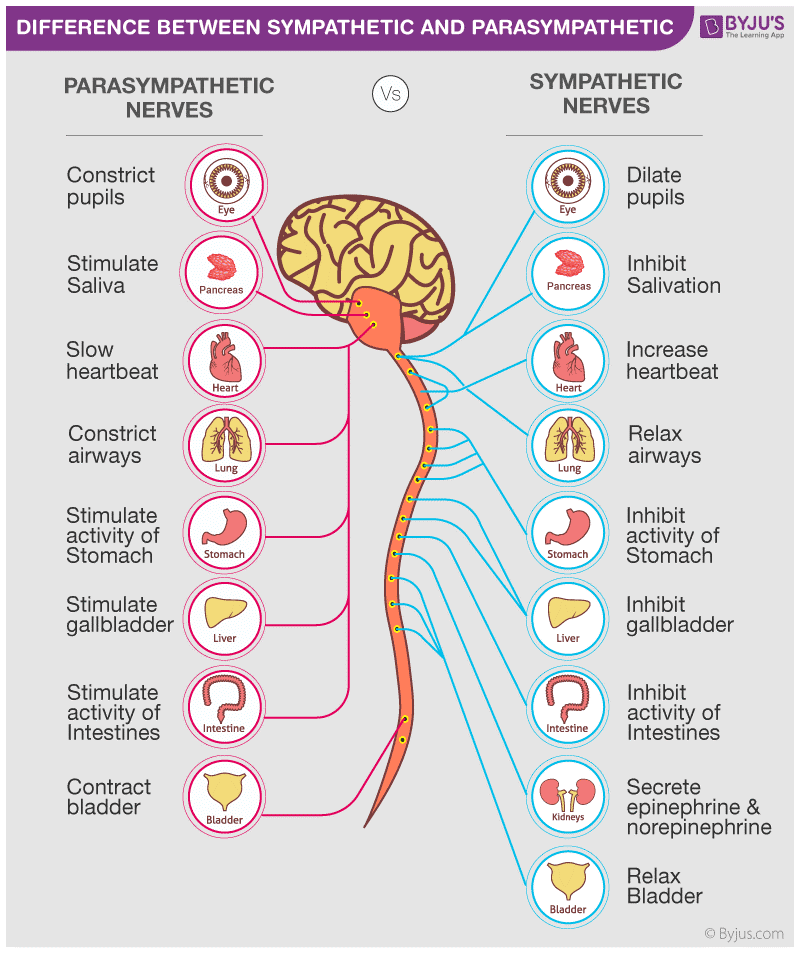
The body cannot stay in this heightened state of arousal for long as it puts physical stress on the body so the counter system, parasympathetic or rest and digest, kicks in when the danger is over. It restores the body to balance, kick starting digestion, healing, immune responses.
But what happens if the parasympathetic nervous system fails?
Well, you will not be surprised to hear that’s where stress, anxiety disorders and worry can come from. They make sure the parasympathetic nervous system can’t do its job. In more serious situations like Post Traumatic Stress Disorder the sympathetic nervous system doesn’t turn off and a condition of hyperarousal occurs. This is where the brain and body are in a continuous loop of telling each other that they are still in danger.
Breath work can help. It’s about giving the parasympathetic nervous system a hand.
Other therapies for like CBT are used to manage the cognitive and behavioural roots of anxiety disorders; to stop telling the body it’s in danger. Breath work can work in tandem to manage the symptoms and the effect they have on keeping the person in an aroused stated
How can we help the parasympathetic Nervous System ?
We learn specific breathing techniques; feel the benefits; practice them regularly; feel the long term benefits and then, as it becomes part of lives, we forget how we used to be.
In this part I, I will introduce simple techniques that can be combined:
- Belly Breathing ( diaphragmatic breathing)
- Resonant Breathing
- Pursed Lips Breathing
- Restrictive Breathing ( Seashell breathing)
- Breath Moving
Part 2 will look at :
- HA ! breathing
- Breath Counting
- Vibrational breathing using “OM”
Belly Breathing
What’s the point ? How does it Work ?
Well, I must admit that until I understood the science and then felt the positive effect I was reluctant to put any real effort in diaphragmatic breathing. The other way of breathing is called chest breathing and can make the body feel tense and nervous as it is how we breath when we are feeling under threat.
The diaphragm is a dome-shaped muscle, which separates our chest and abdomen. When we breathe in the diaphragm tightens, flattens and moves down, sucking air into the lungs. As the diaphragm moves down, it pushes the abdominal contents down, which forces the abdominal wall out. When we breathe out the diaphragm relaxes, air passes out of the lungs and the abdominal wall flattens. This type of breathing has two important effects on the body:
- It is in itself relaxing compared to the ‘emergency mode’ breathing of the upper chest, which is an integral part of ‘fight or flight’ response to a stressful situation (see the Stress management leaflet for more information).
- It is typical of the regenerating processes such as when you are asleep, digesting food or the body is at peace. You can see it in the way babies and children breathe.
Abdominal (diaphragmatic) breathing is the most efficient and relaxed way of getting enough air into your lungs. Breathing too quickly, too deeply or irregularly can result in unpleasant symptoms such as dizziness, faintness, headache, visual disturbance, tingling, chest pain, palpitations, sighing, yawning and excessive sniffing. It can commonly become a trigger for anxiety
How to Do It
Find a quiet room where you will be undisturbed for about 10–15 minutes.

- Lie down on the bed or floor with a pillow under your knees. Undo tight clothing and remove your shoes. Spend a few moments settling yourself down.
- Close your eyes, spread your feet 12–18 inches apart, and check that your head, neck and spine are in a straight line.
- Focus your attention on your breathing. Do not try to change your breathing for the moment. Become aware of how fast or slow you are breathing, whether you are breathing with your chest or diaphragm. Notice whether there are any gaps or pauses between your inhalation or exhalation.
- Now, put one hand on your upper chest, and one hand on your abdomen just below your rib cage. Relax the shoulders and hands. As you breathe in, allow the abdomen to rise, and as you breathe out, allow the abdomen to flatten. There should be little or no movement in the chest. 6
- Allow yourself a little time to get into a regular rhythm. It may help to imagine that as you are breathing in, you draw half a circle with your breath around your body, and as you breathe out, you complete the other half of the circle. Allow your breath to become smooth, easy and regular.
- Now, slow down your breathing out, then be conscious of a comfortable pause before allowing your breaths in to follow smoothly and easily. If any distractions, thoughts or worries come into your mind, allow them to come, then allow them to go, and bring your attention back to your breathing.
- When you are ready to end this exercise, take a few deeper breaths in. Bring some feeling back into your fingers and toes. Open your eyes slowly, and turn over onto one side before gently sitting up.
Part 2 to follow

Author Info

No Comments